
How Saree Is Made: A Simple Step-by-Step Guide
Have you ever wondered how a saree is made?
A saree may look like one simple piece of cloth. But making one can involve many steps. It starts with raw fibers and ends with a finished saree that is ready to wear.
The process depends on the type of saree. Cotton, silk, linen, and synthetic sarees do not always use the same methods. Handloom sarees also need more manual work than powerloom sarees.
A saree can include many details. These may include a border, pallu, woven patterns, zari, embroidery, prints, or other decorations.
Skilled weavers and other workers handle different parts of the process. They choose the material, prepare the yarn, add color, set the loom, weave the fabric, and check the finished saree.
In this guide, we will explain how sarees are made from start to finish. We will also look at the materials used, the weaving process, different saree fabrics, handloom and powerloom sarees, and the time needed to make a saree.
How Saree Is Made – What Is a Saree Made Of?
The first step in understanding how a saree is made is knowing what materials go into it.
Sarees can use many different fabrics. Each fabric has its own texture, weight, shine, and drape.
The choice of fabric also affects how the saree is made.
How Saree Is Made : Cotton
Cotton is one of the most common saree fabrics.
Cotton sarees are soft and breathable. They are comfortable in warm weather. Many people wear them for daily use, work, and casual occasions.
Cotton yarn is made from cotton fibers. The yarn is then dyed and woven into fabric.
How Saree Is Made : Silk
Silk is known for its smooth texture and natural shine.
Silk sarees are popular for weddings, festivals, and special occasions. Many traditional silk sarees also include zari work and detailed designs.
Silk sarees often need careful handling during production. The quality of the silk yarn can affect the final look and feel.
How Saree Is Made : Georgette
Georgette is a lightweight fabric.
It has a soft and flowy drape. It is often used for party-wear and modern sarees.
The fabric is easy to style and works well with printed or embroidered designs.
How Saree Is Made : Chiffon
Chiffon is another light fabric used for sarees.
It is thin and flowy. Chiffon sarees often create a soft and elegant drape.
How Saree Is Made : Crepe
Crepe has a slightly textured surface.
It is commonly used for modern sarees. It can hold prints and colors well.
How Saree Is Made : Linen
Linen sarees have a natural texture.
They are light and breathable. They are often chosen for simple and comfortable looks.
How Saree Is Made : Rayon
Rayon is a soft fabric that can be used to make affordable sarees.
It can also copy the look and feel of some natural fabrics.
How Saree Is Made : Other Materials Used in Saree Making
The main fabric is only one part of the process.
Depending on the saree, makers may also use:
- Cotton yarn
- Silk yarn
- Synthetic yarn
- Dyes
- Zari
- Decorative threads
- Sequins
- Beads
- Embroidery threads
- Stones
- Printing colors
The materials depend on the design and type of saree.
A simple cotton saree may need only yarn and dye. A bridal silk saree may need silk yarn, zari, multiple colors, and detailed decorative work.
How Is a Saree Made? Step-by-Step Process
Now let’s look at the main steps involved in the saree-making process.
1. Selecting the Raw Material
The process starts with the raw material.
The maker first decides what type of saree they want to produce. This decision determines the type of fiber or yarn needed.
Cotton sarees use cotton fibers. Silk sarees use silk fibers. Synthetic sarees use man-made fibers.
The quality of the raw material matters.
Good-quality fibers can produce strong and smooth yarn. Poor-quality fibers can make the yarn weak or uneven.
The maker also considers the thickness of the yarn. Different saree designs need different yarn thicknesses.
For example, a lightweight saree may need fine yarn. A heavier saree may use thicker yarn.
After selecting the raw material, it goes through the next stage.
2. Cleaning and Preparing the Fibers
Raw fibers need cleaning before they can become yarn.
The fibers may contain dirt, small particles, or unwanted material. These need to be removed.
The fibers are then separated and straightened.
This makes them easier to spin into yarn.
The exact method depends on the type of fiber.
Cotton, for example, needs different preparation from silk.
Once the fibers are clean and ready, they can be turned into yarn.
3. Spinning the Yarn
The next step is spinning.
Spinning turns loose fibers into long threads called yarn.
The fibers are pulled and twisted together. This gives the yarn strength.
Machines can handle this process in large factories. Traditional methods may use hand-operated tools.
The yarn needs the right amount of twist.
If the yarn is too weak, it may break during weaving. If it is too tightly twisted, it may affect the texture of the fabric.
The finished yarn is then prepared for dyeing or weaving.
4. Dyeing the Yarn
Many sarees get their color before the weaving process.
The yarn is placed in a dye solution. The dye enters the yarn and gives it the required color.
The maker must control the dyeing process carefully.
The amount of dye, temperature, and time can affect the final shade.
After dyeing, the yarn is washed. This removes extra dye.
The yarn is then dried.
Some sarees use one main color. Others use several colors.
For a multicolored saree, different sets of yarn may receive different colors.
Traditional sarees may also use natural dyes made from plants, flowers, leaves, bark, or other natural materials.
5. Preparing the Warp and Weft
This is one of the most important parts of the saree weaving process.
A woven fabric uses two main sets of threads.
These are called the warp and the weft.
What Is the Warp?
The warp consists of threads that run along the length of the saree.
These threads are placed on the loom first.
The warp needs to stay straight and evenly spaced.
What Is the Weft?
The weft is the thread that moves across the warp.
The weaver passes the weft through the warp. This creates the fabric.
The warp and weft work together to create a strong woven structure.
The type of yarn and the way the threads are arranged can change the final texture of the saree.
6. Setting Up the Loom
The loom is the main tool used to weave the saree.
The weaver places the warp threads on the loom.
This step requires care.
The threads must have the correct spacing and tension. If the threads are too loose or too tight, the fabric may not form correctly.
The loom is then set according to the saree design.
A handloom requires the weaver to control the weaving process manually.
A powerloom uses a machine to move the threads.
The loom setup can take time, especially for detailed saree designs.
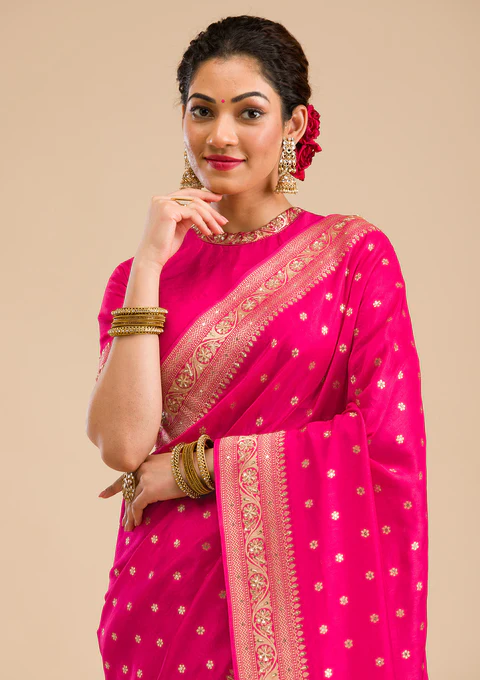
7. Weaving the Saree
Now the saree fabric starts to take shape.
The weaver passes the weft thread through the warp threads.
The threads are then pushed together to create a firm fabric.
This process continues row by row.
The weaver must watch the fabric while working.
They check the width, texture, pattern, and thread tension.
In a simple saree, the weaving pattern may be easy.
In a detailed saree, the weaver may need to follow complex patterns.
This is especially true for traditional handloom sarees.
The weaving time depends on the saree.
A simple saree may take less time. A detailed saree with complex patterns can take many days.
8 Creating the Saree Body
The main part of the saree is called the body.
This is the large section of fabric between the borders and the pallu.
The body can have many different designs.
It may be plain or include:
- Floral patterns
- Geometric designs
- Traditional motifs
- Small dots
- Stripes
- Checks
- Woven patterns
Some designs are created during weaving.
Others are printed or added later.
The choice depends on the type of saree.
9. Creating the Border
The border runs along the edge of the saree.
It can be narrow or wide.
Some sarees have a border in a contrasting color. Others use the same color as the main body.
Traditional sarees may have detailed woven borders.
The border can include:
- Floral designs
- Geometric patterns
- Zari
- Stripes
- Traditional motifs
In some handloom sarees, the border is created directly on the loom.
This requires skill and careful control of the threads.
10. Creating the Pallu
The pallu is the decorated end of the saree.
It is often one of the most noticeable parts of the saree.
The pallu can use a different color or pattern from the main body.
Some pallus have large floral designs. Others use geometric patterns or traditional motifs.
Silk sarees often have detailed pallus with zari work.
The pallu may take extra time to weave because of its detailed design.
11. Adding Zari and Other Decorations
Many Indian sarees use decorative work.
Zari is one of the most common forms of decoration.
It is a shiny thread used to create patterns and borders.
Zari can be woven into the fabric. It can also be added as decorative work after weaving.
Other decorations may include:
- Embroidery
- Sequins
- Beads
- Stones
- Thread work
- Appliqué work
- Printed designs
The type of decoration depends on the saree.
A simple everyday saree may have very little decoration.
A wedding saree may have heavy zari and embroidery work.
12. Finishing the Saree
The saree is not ready when weaving ends.
It needs finishing work.
First, workers inspect the fabric.
They look for:
- Broken threads
- Loose threads
- Uneven weaving
- Color problems
- Design mistakes
- Other visible defects
Loose threads are removed or fixed.
The saree may then be washed or treated to improve its texture.
Some fabrics may also go through softening or polishing.
The saree is then pressed or ironed.
This gives it a neat appearance.
13. Quality Checking
Quality checking is an important final step.
The entire saree is checked before it reaches the customer.
Workers check the fabric from one end to the other.
They inspect the body, border, and pallu.
They also check the color and overall finish.
If they find a problem, they may fix it before packaging.
This step helps make sure the finished saree meets the required quality.
14. Folding and Packaging
After the final check, the saree is folded carefully.
The folding method helps protect the fabric during storage and transport.
The saree is then packed.
It can now be sent to a store, warehouse, or customer.
At this point, the journey from raw fiber to finished saree is complete.
How Saree Is Made : How Different Types of Sarees Are Made
Different sarees can use different production methods.
How Silk Sarees Are Made
Silk sarees start with silk fibers.
The fibers are prepared and turned into yarn.
The yarn is then dyed and prepared for weaving.
The weaver sets the yarn on the loom and creates the fabric.
Many silk sarees have detailed borders and pallus.
Some also include zari work.
Traditional handwoven silk sarees can take a long time to complete because of their detailed designs.
How Cotton Sarees Are Made
Cotton sarees start with cotton fibers.
The fibers are cleaned and spun into yarn.
The yarn can then be dyed.
The weaver places the yarn on the loom and starts weaving.
Cotton sarees can have plain bodies or printed and woven designs.
They are popular because they are light, breathable, and comfortable.
How Handloom Sarees Are Made
Handloom sarees are woven using manually operated looms.
The weaver controls the loom during the process.
They handle the yarn and follow the design by hand.
This process needs skill and patience.
A handloom saree can take several days or longer, depending on its design.
Each saree can also have small differences because it is made by hand.
How Saree Is Made : How Printed Sarees Are Made
Printed sarees follow a different process.
The base fabric is first prepared.
A design is then applied to the fabric using a printing method.
The print can include flowers, geometric patterns, traditional designs, or modern artwork.
After printing, the fabric is dried and finished.
The final saree is then checked before packaging.
How Saree Is Made : Handloom vs Powerloom Sarees
Handloom and powerloom sarees are made using different weaving methods.
| Feature | Handloom Saree | Powerloom Saree |
|---|---|---|
| Weaving | Mainly done by hand | Done using machines |
| Speed | Slower | Faster |
| Production | Lower | Higher |
| Skill | Needs trained artisans | More machine-based |
| Design | Can include detailed traditional work | Can produce many designs |
| Price | Often higher | Often more affordable |
Both methods can produce good sarees.
The main difference is the production method and the amount of manual work involved.
How Saree Is Made : How Long Does It Take to Make a Saree?
There is no single answer.
The time depends on the type of saree.
A simple machine-made saree can be produced quickly.
A basic handloom saree can take several days.
A saree with detailed patterns can take much longer.
Zari work and embroidery can also increase the production time.
The fabric matters too.
A simple cotton saree may need less time than a detailed silk saree.
The skill of the artisan also affects the process.
How Saree Is Made :Why Are Handwoven Sarees More Expensive?
Handwoven sarees often cost more than machine-made sarees.
One reason is the amount of manual work involved.
A skilled weaver may spend many hours or days working on one saree.
Detailed patterns need extra attention.
The materials can also affect the price.
The cost may depend on:
- Fabric quality
- Yarn quality
- Weaving method
- Design complexity
- Zari work
- Embroidery
- Production time
- Artisan skill
When you buy a handwoven saree, you are paying for both the material and the work behind it.
Frequently Asked Questions About How Sarees Are Made : How Saree Is Made
How is a saree made?
A saree is made by turning fibers into yarn, dyeing the yarn, preparing the warp and weft, and weaving the fabric. The maker then creates the border and pallu. Decorations and finishing work are added before the final quality check.
What fabric is used to make sarees?
Sarees can be made from cotton, silk, georgette, chiffon, crepe, linen, rayon, and many other fabrics.
How long does it take to make a saree?
The time depends on the fabric, design, weaving method, and amount of decoration. A simple saree may take less time. A detailed handwoven saree can take several days or longer.
How are silk sarees made?
Silk fibers are turned into yarn. The yarn is dyed and prepared for weaving. The weaver then creates the saree on a loom. Many silk sarees also have zari, detailed borders, and decorative pallus.
What is the difference between handloom and powerloom sarees?
Handloom sarees are woven mainly by hand. Powerloom sarees are woven using machines. Handloom weaving is slower and needs skilled artisans.
Why are handloom sarees expensive?
Handloom sarees can cost more because they require more manual work and time. Complex designs and high-quality materials can also increase the price.
What is the pallu of a saree?
The pallu is the end section of the saree. It is often more decorative than the main body. Many sarees have detailed patterns or zari work on the pallu.
What is the border of a saree?
The border is the decorative strip along the edge of the saree. It can be simple or highly detailed.
How Saree Is Made : Final Thoughts
Now you know how saree is made.
The process starts with raw fibers. The fibers become yarn. The yarn is dyed and prepared for weaving. The weaver then uses a loom to create the fabric.
After that, the border and pallu are created. Some sarees also receive zari, embroidery, prints, or other decorations.
The saree then goes through finishing and quality checks. Finally, it is folded and packed.
Every saree has its own story. the use ai tools like chatgpt to improve your work .
The fabric, weaving method, design, and work of the artisan all affect the final product.
A saree may look like a simple piece of clothing. But making one can involve many steps and hours of skilled work. Understanding this process can help you appreciate the effort behind every saree you wear.A saree may look like a simple piece of clothing. But making one can involve many steps and hours of skilled work. Understanding this process can help you appreciate the effort behind every saree you wear.
i hope you have now got the answer to your question : How Saree Is Made
for more information check our Home page .
